Alibaba Group Holding Limited (BABA) shares took a dive Friday, and if you’re wondering why, you don’t have to look much further than a headline that dropped like a lead balloon: Alibaba dips after White House memo claims it's helping Chinese military target US: report (BABA:NYSE). For a stock that’s shown remarkable resilience this year, this isn't just a bump; it’s a potential tectonic shift in how the market views its risk profile.
The news, courtesy of the Financial Times, cites a White House national security memo containing declassified top-secret intelligence. This memo, which the Times pointedly noted it couldn't independently verify (a crucial detail, wouldn't you say?), paints a picture of Alibaba providing the Chinese government and its People’s Liberation Army access to customer data – think IP addresses, WiFi information, payment records – along with various AI-related services. Essentially, the implication is that BABA isn't just a tech company; it's an arm of Beijing’s intelligence apparatus.
Alibaba's swift denial—calling the allegations "false" and the leak a malicious attempt to "malign the company"—is exactly what you’d expect. What else can they say? But it begs the question: how much smoke does it take to signal a fire in this geopolitical fog? The source of this declassified memo, and the specific, incontrovertible evidence beyond the memo itself, remains frustratingly vague. As an analyst, I always look for the verifiable data, and right now, we're operating on a whisper from a sensitive document. This lack of independent verification is a massive asterisk next to the entire story, yet the market is reacting as if it’s gospel.
Now, let's talk about the numbers, because that’s where the rubber meets the road. BABA had been on a tear, up a frankly impressive 79.9% year-to-date. That’s resilience, plain and simple, especially considering the regulatory headwinds it’s faced over the past few years. You could practically hear the collective gasp across trading floors as the headlines hit, watching those green numbers on BABA’s year-to-date chart suddenly get splashed with a fresh coat of red. Then came Friday's news, and the stock promptly shed 4.73% (that’s a roughly $7.50 drop per share, to be more exact, from its Thursday close) to land at $152.31.
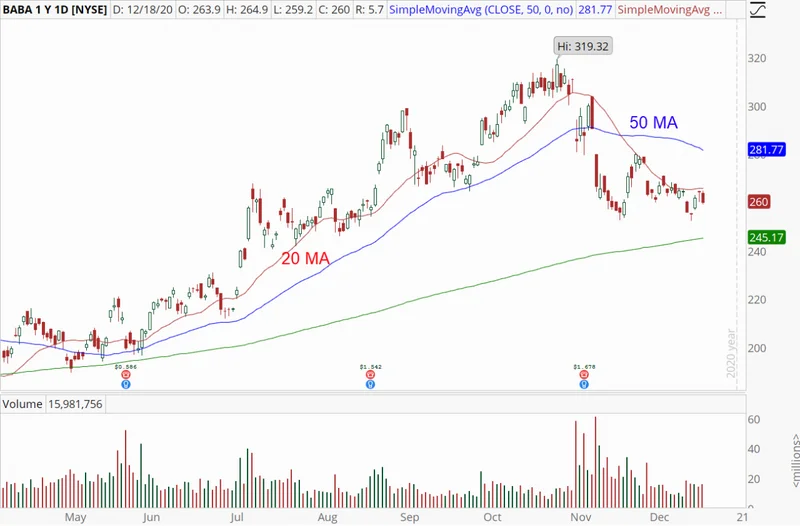
The Relative Strength Index (RSI) is sitting at 42.94. For the uninitiated, that’s neutral territory (meaning it’s neither overbought nor oversold, just...in limbo). This suggests that while the immediate reaction was sharp, the stock isn’t yet in a panic-sell situation, at least by this metric.
Technical levels are now more critical than ever. Support is pegged around $130.06. Think of that as the market’s safety net. If BABA keeps sliding, that’s where traders are likely to step in, hoping for a bounce. But the resistance, the ceiling it needs to break through for a real recovery, is up at $170.55. It’s a bit like watching a a tightrope walker over a canyon; they've got a long way to go to reach the other side, and one wrong step could send them down to that support level, or worse. The proximity to the 50-day moving average makes this a pivotal moment; a bounce could signal opportunity, a break below, further weakness. My analysis of similar situations suggests that while technicals offer a roadmap, geopolitical tremors can turn that map into a crumpled mess overnight. What good is a resistance level when the entire market narrative shifts?
This isn't just about one unverified report; it's about the ever-present sword of Damocles hanging over Chinese tech firms operating on the global stage. The market, in its infinite wisdom, is pricing in risk. Alibaba’s denial is boilerplate. What else can they say? But the underlying current here is the increasing pressure from Washington on any company perceived to be aiding Beijing’s strategic ambitions. It's a game of high-stakes poker, and BABA just got dealt a particularly tricky hand, especially with the current narrative of US-China decoupling intensifying.
How much of this Friday dip is a knee-jerk reaction, and how much is a genuine re-evaluation of long-term geopolitical risk? That’s the multi-billion-dollar question that investors need to be asking themselves. The strong year-to-date performance for baba stock price highlights its operational strength, but these external, non-financial risks are becoming impossible to ignore. For a company like Alibaba, navigating the complex web of Chinese government directives and international market expectations is a balancing act that gets harder with every new allegation.
Alibaba is caught in a familiar bind: an economic powerhouse with deep ties to an authoritarian government. Whether these specific allegations are true or not, the fact that they can be credibly raised and impact the stock so significantly proves one thing: the geopolitical discount on Chinese tech stocks is not going away. In fact, it just got a whole lot deeper. Investors can no longer simply look at user growth or cloud revenue; they now have to factor in the potential for a White House memo to wipe billions off the market cap. That’s a risk premium that's becoming increasingly difficult to quantify, let alone stomach.